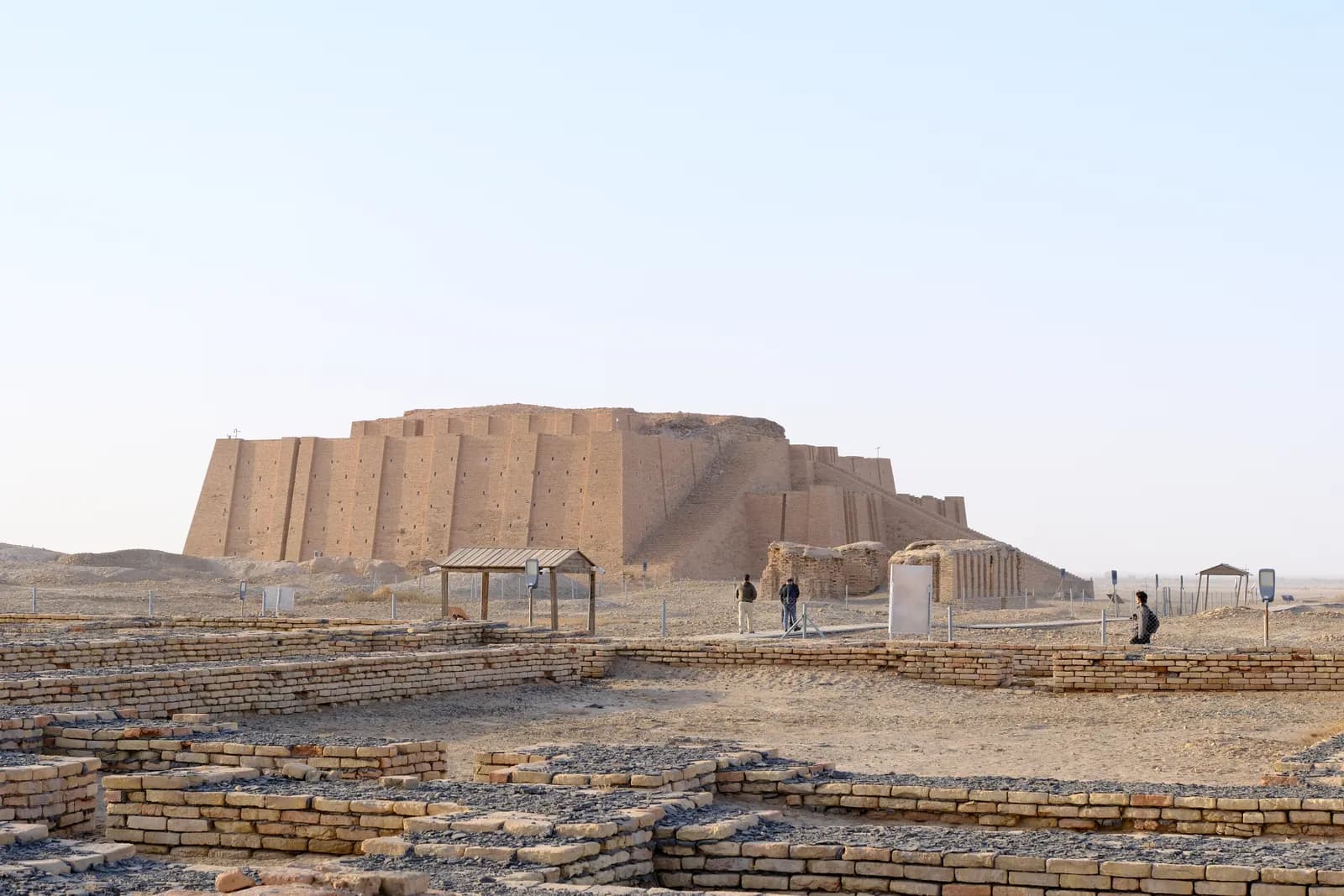
Where the site is
A mound in the alluvial plain of southern Iraq. In the third millennium BCE the Euphrates ran close by and the head of the Gulf was much nearer than it is now, so Ur was a river and sea port; both the river and the coast have since moved, leaving the site in dry desert.
- Ancient region
- Sumer
- Modern country
- Iraq
- Position
- 30.963° N, 46.103° E — The ziggurat of Ur-Nammu
- Given to three decimal places, about a hundred metres. It locates the named feature, not the extent of the site.
What survives
The ziggurat's lowest stage stands, faced in baked brick set in bitumen, with three converging stairways of a hundred steps meeting at a landing. The upper stages are lost; what a visitor sees above the first terrace is largely a reconstruction carried out in the 1980s.
Around it, the temple precinct, the residence of the entu priestess, storehouses, and beyond them the excavated streets of a residential quarter of the early second millennium — courtyard houses of two storeys with chapels and family burials under the floors.
The Royal Cemetery itself is an area of ground. Its contents are in three cities on two continents.
Occupation and chronology
Dates below are stored as signed years and rendered with the precision they actually carry. c. 5000 BCE is approximate; c. 400 BCE is approximate.
c. 5000–2900 BCE
Early occupation
Ubaid and Uruk-period levels beneath everything else, reached only in deep soundings.
c. 2600–2450 BCE
The Royal Cemetery
Early Dynastic III. Around eighteen hundred graves, of which sixteen were built tomb chambers with attendant burials and extraordinary quantities of gold, silver, lapis and carnelian.
c. 2112–2004 BCE
The Third Dynasty of Ur
The city's political peak under Ur-Nammu and Shulgi: the ziggurat, the great temple precinct, and an administrative apparatus that produced tens of thousands of tablets.
2000–400 BCE
Later city
Occupied under Isin-Larsa, Babylonian and Kassite rule; the ziggurat restored by Nabonidus in the sixth century BCE, whose own excavations of earlier foundations make him a plausible candidate for the first archaeologist. Abandoned as the river shifted.
History of excavation
Who recovered the evidence, when, and by what method. Where an excavation destroyed as much as it found, the entry says so.
- Evidence level: Documented
1853–1854
John George Taylor for the British Museum
Taylor dug into the ziggurat corners and found inscribed foundation cylinders of Nabonidus naming the building and its original builder, which identified the site as Ur.
- Evidence level: Documented
1922–1934
Leonard Woolley, for the British Museum and the University of Pennsylvania Museum
Twelve seasons. The ziggurat, the temple precinct, the houses, the deep sounding, and from 1926 the Royal Cemetery. Woolley was an exceptional excavator of fragile material — he recovered the lyres by pouring plaster into the voids their decayed wood had left — and an enthusiastic publicist, which is the source of both his reputations.
- Evidence level: Documented
1929
Woolley's flood announcement
A deep sounding produced a sterile silt layer some two and a half metres thick between occupation levels. Woolley announced it as the flood of Genesis. The layer is real; comparable layers at other Mesopotamian sites are not contemporary with it, and it records a severe local inundation.
- Evidence level: Documented
1980s and 2009–present
Iraqi restoration, and the joint Iraqi–American missions
The ziggurat's lower stages were rebuilt under the Iraqi government. Later work has concentrated on survey, conservation and the reassessment of the older excavation records, including a re-examination of the skeletal material in Philadelphia.
Principal structures
The evidence level answers how we know what a structure looked like, not whether it existed.
- Evidence level: Documented
c. 2100 BCE, restored 6th century BCE
The ziggurat of Ur-Nammu
A stepped platform of mudbrick faced with baked brick, with weeper holes to let the core dry. The lowest stage is largely ancient; what stands above it is modern reconstruction and should be read as such.
- Evidence level: Documented
c. 2600–2450 BCE
The Royal Cemetery
Built stone and brick chambers at the bottom of shafts, approached by ramps, with the attendant burials laid out in the shaft rather than in the chamber.
- Evidence level: Documented
c. 2100 BCE and later
The Giparu
The residence of the entu, the high priestess of the moon god, an office held by royal daughters. Enheduanna, daughter of Sargon of Akkad and the earliest author in world literature whose name is attached to her work, held it centuries earlier.
- Evidence level: Documented
c. 1900 BCE
The houses of Area AH
A quarter of courtyard houses with streets, drains, private chapels and burials beneath the floors, together with school tablets. Domestic Mesopotamian life at a level of detail available at very few sites.
Finds and where they went
Almost nothing recovered from these sites is still on them. Where an object has a full provenance record on this platform, it is linked.
- Evidence level: Documented
The Standard of Ur
A hollow box inlaid in shell, lapis and red limestone, with a register of war on one side and one of feasting on the other. Its original function is unknown — Woolley's guess that it was a standard carried on a pole is a guess, and the name has stuck.
- Evidence level: Documented
The tomb of Puabi
An undisturbed chamber with a headdress of gold leaves and lapis, a cylinder seal naming her, and attendants in the shaft outside. Her title has been read as queen and as lady; whether she ruled or was the wife of a ruler is not settled by the seal.
- Evidence level: Documented
The Ram in a Thicket
A pair of goat figures on their hind legs against a flowering plant, in gold, lapis and shell. Woolley named them for Genesis. One is in London and one in Philadelphia, and both were reconstructed around the decayed originals.
- Evidence level: Documented
The Great Lyre and the attendants
Lyres with bull's-head sound boxes, recovered by casting the voids left by their vanished wood, found among the bodies of the people buried with the tomb owners.
University of Pennsylvania Museum, and the Iraq Museum, Baghdad
- Evidence level: Documented
The Disk of Enheduanna
A carved alabaster disk showing the priestess officiating at an altar, with an inscription naming her as daughter of Sargon and entu of Nanna. The earliest securely identified portrait of a named author.
University of Pennsylvania Museum
Ancient testimony
What ancient authors say about the place, and how far it can be trusted.
The Epic of Gilgamesh Tablet XI
The Babylonian flood narrative, recovered from Nineveh rather than Ur, and the reason a silt layer in southern Iraq was read as biblical in the first place. It predates the Genesis account and shares its structure.
The Sumerian King List
Lists dynasties of Ur among the cities holding kingship, with reign lengths that are plainly schematic. A native chronological framework, and one that has to be used with the greatest caution.
Nabonidus, The Nabonidus cylinders Ur foundation deposits
The last Babylonian king's record of restoring the ziggurat and of investigating the foundations of earlier builders. He names Ur-Nammu, which is how the building was attributed.
How the site has been interpreted
The Royal Cemetery is the single most difficult body of evidence in Mesopotamian archaeology, because what it documents is not in doubt and what it means is entirely unclear. Dozens of people — soldiers with weapons, women with elaborate headdresses, grooms with oxen and carts — were placed in a burial shaft alongside a principal body, in careful order, and buried. Nothing in Sumerian literature describes the practice, and it appears at Ur, in this form, for a couple of generations only.
Woolley's reconstruction, that the attendants processed in, drank a drug from the cups found beside them and lay down, is elegant and has shaped every popular account since. Re-examination of two skulls in the 1990s and 2000s found perimortem fractures consistent with a heavy blow, and traces suggesting bodies were heated and treated with mercury compounds before burial. The picture is now less peaceful and considerably less clear.
The site is also a case study in how excavation is funded and reported. Woolley wrote for newspapers, and his interpretations — the flood, the ram in the thicket, Ur of the Chaldees — were pitched to a public that read Genesis. That does not make the excavation dishonest; his records are unusually good. It does mean that the framing of the finds needs to be separated from the finds themselves.
The identification with the Ur of Abraham is traditional rather than demonstrated. The biblical text says Ur of the Chaldees; the Chaldeans are a first-millennium presence, well after the period the patriarchal narratives are usually placed in, and a northern Mesopotamian Ur has also been proposed. The site's importance does not depend on the connection.
Unresolved
How did the attendants die?
Woolley proposed voluntary poison, on the evidence of the cups and the orderly arrangement. The cranial fractures found in later CT work indicate at least some deaths by blunt force, and the evidence of post-mortem heating suggests bodies were prepared over a period rather than buried immediately. Whether participation was voluntary, coerced or a matter of status obligation is not recoverable from the bodies.
What was Woolley's flood layer?
A thick sterile silt deposit between occupation levels is a fact of the section. Similar deposits at Kish, Shuruppak and Uruk are at different depths and different dates, so no single event is recorded across the region. The layer documents a major flood at Ur, and Mesopotamian flood literature long predates Genesis, which is the more useful connection.
How to read the evidence labels
- Evidence level: Documented
- Supported by a named primary text or by excavated material evidence.
- Evidence level: Probable
- Supported by strong inference that most specialists accept.
- Evidence level: Disputed
- Substantial specialist disagreement exists; competing readings are stated.
- Evidence level: Literary
- Belongs to poetic or mythological construction rather than to history.
- Evidence level: Mythological
- Belongs to shared religious or mythic tradition rather than to any single text.
- Evidence level: Unknown
- The available evidence is insufficient to decide.
These labels describe the status of the evidence, not our confidence in a conclusion. A claim marked Literary is not a claim we doubt; it is a claim about what kind of thing a poem is.