What Mycenaean Greece was
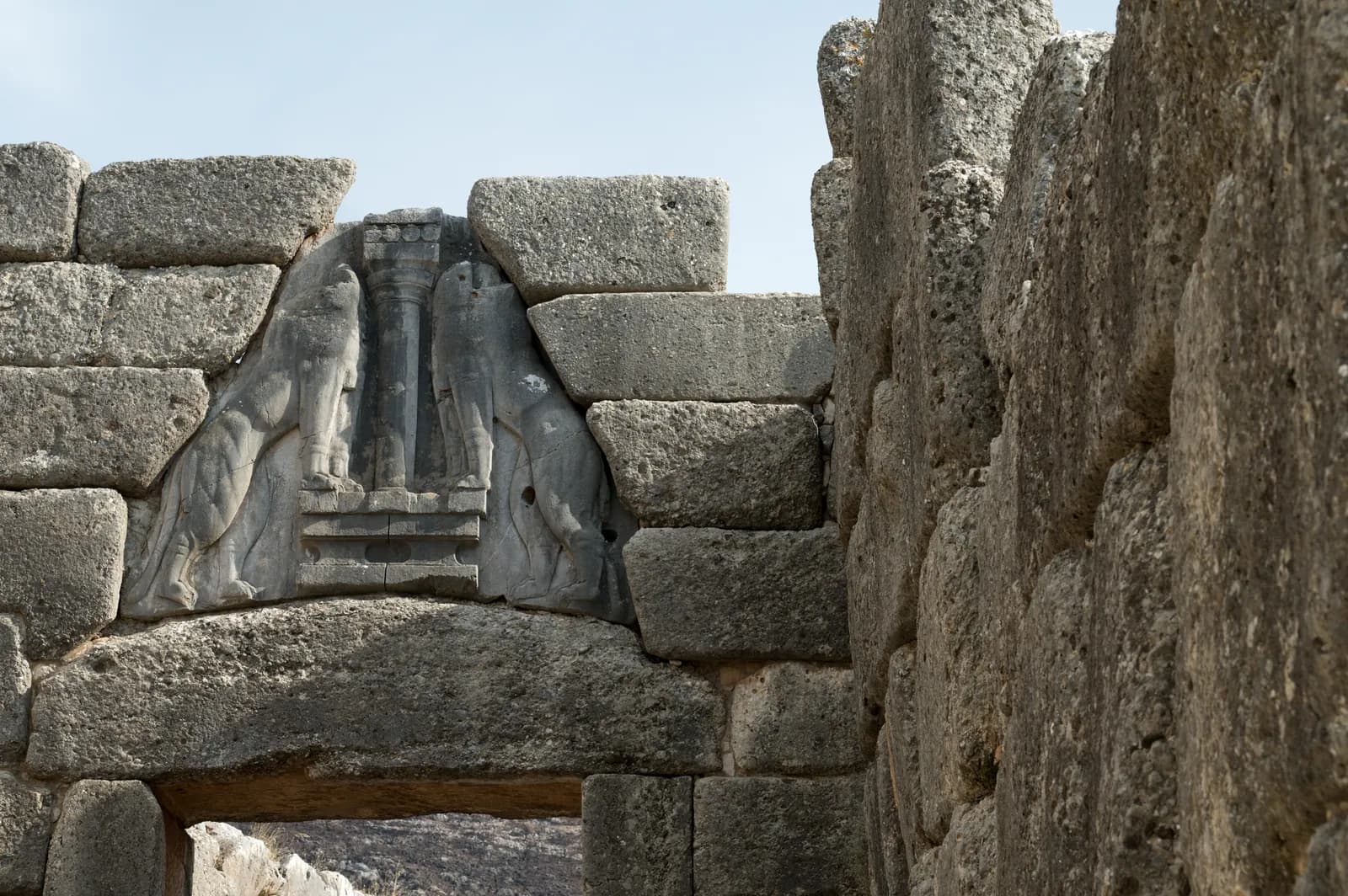
The Late Bronze Age Aegean, roughly the fifteenth to twelfth centuries BCE, held a network of palace centres — Mycenae, Pylos, Tiryns, Thebes, Knossos on Crete — with monumental architecture, fortification walls of enormous unworked blocks, shaft graves and tholos tombs, frescoed halls, and long-distance trade reaching Egypt and the Levant.
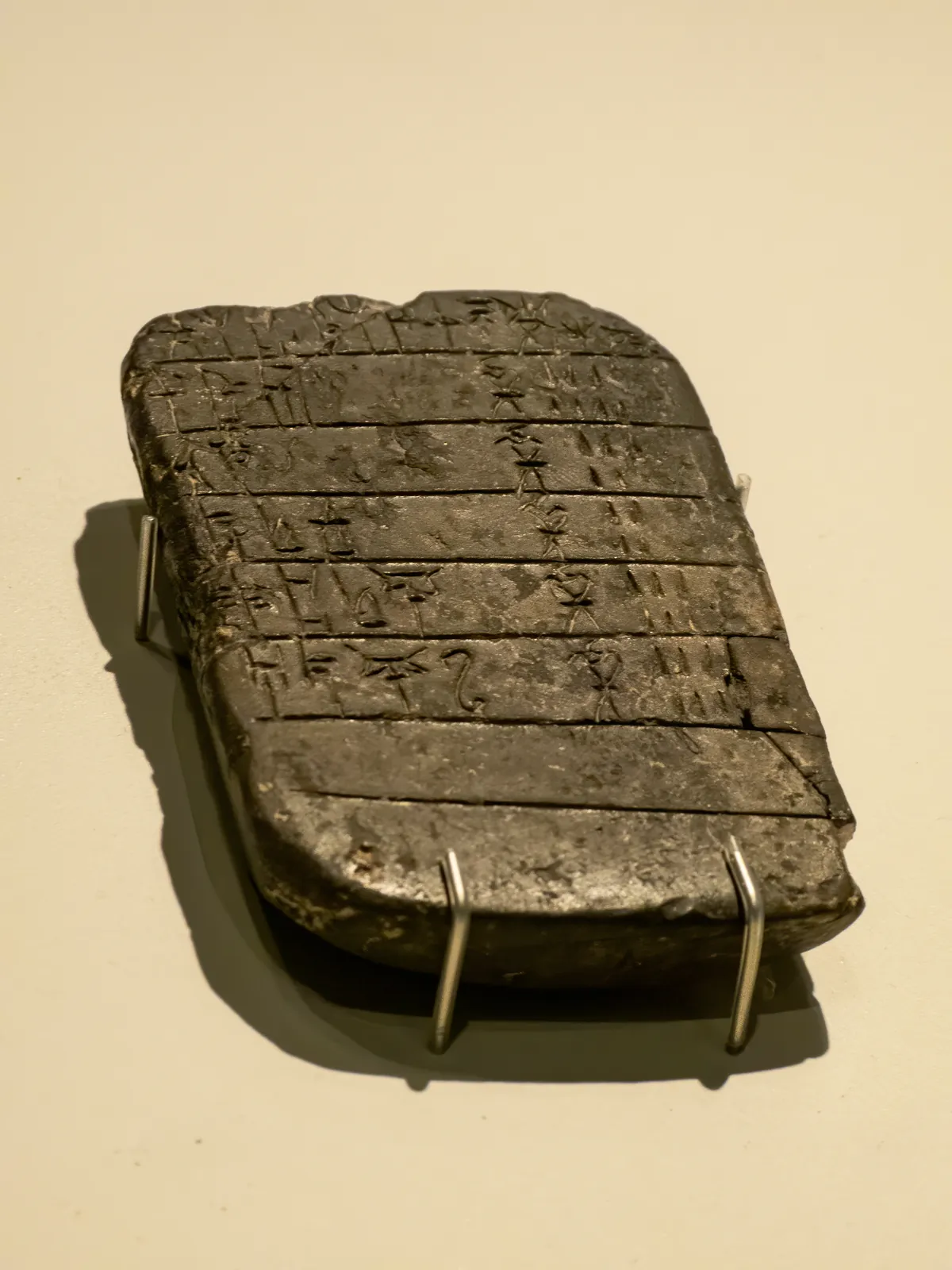
The decisive evidence is documentary. The Linear B tablets, deciphered by Michael Ventris with John Chadwick in 1952, are administrative records in an early form of Greek. They were preserved by accident: unfired clay, baked hard in the fires that destroyed the palaces.
Mycenaean palaces ran literate bureaucracies in Greek.
The tablets record land tenure, rations, personnel, textiles, bronze allocations, chariot inventories and offerings to named deities. They imply scribes, standard units, and centralised redistribution.
Linear B archives, Pylos and Knossos above all
Deities later worshipped in historical Greece are already named in the tablets.
Theonyms corresponding to Poseidon, Zeus, Hera, Hermes, Athena and Dionysus appear as recipients of offerings. Poseidon appears especially prominent at Pylos.
Linear B religious records
What the poem describes instead
The Odyssey's world has none of the bureaucracy. There is no writing in it — the single apparent reference to written signs, the folded tablet in the Bellerophon story in the Iliad, is famously obscure and is not literacy in the Linear B sense. There are no scribes, no inventories, no redistribution, no officials.
Authority is personal. A basileus leads because he is well-born, wealthy, capable and listened to. Wealth is held as treasure and livestock and moved by gift-exchange rather than by administration. The household, not the palace, is the unit.
Which historical society, if any, the poem's social world reflects.
Finley's argument was that it broadly fits the Early Iron Age, the tenth to ninth centuries. Others place it later still, or hold that it is a poetic construction that never matched any single society. The disagreement is substantial and current.
M. I. Finley, The World of Odysseus, 1954; subsequent debate
What does survive
Some things do carry across, and they are worth naming precisely, because they are the reason the poem cannot simply be dismissed as having no Bronze Age content.
The boar's-tusk helmet described in the Iliad matches excavated Mycenaean examples.
Helmets constructed from split boar's tusks sewn to a leather cap have been excavated from Mycenaean contexts. The description at Iliad 10.261-265 corresponds closely. Note that Iliad 10 is widely held to be among the latest material in that poem, which complicates any simple account of continuous transmission.
Iliad 10.261-265; excavated examples, National Archaeological Museum, Athens
Personal names later borne by Homeric characters occur in Linear B as ordinary names.
Forms corresponding to Achilles and Hector appear in the tablets as the names of unremarkable individuals. This shows the names are old. It does not show the characters are.
Linear B tablets, Knossos and Pylos
The megaron hall plan of the poem broadly reflects Mycenaean palace architecture.
The poem's great hall with a central hearth and a throne is compatible with the excavated megaron at Pylos and elsewhere. The correspondence is general rather than detailed, and the poem's halls are also doing narrative work.
Excavated megara at Pylos, Mycenae and Tiryns
The collapse in between
Between the palaces and the poem lies the destruction of the Mycenaean system around 1200 to 1150 BCE, part of a wider disruption across the eastern Mediterranean. The palaces burned, the administrative system ended, Linear B ceased to be written, monumental building stopped, and population and material complexity fell sharply.
The causes of the Late Bronze Age collapse.
Candidate explanations include migration and raiding, systems collapse in an over-specialised trade network, drought and climate stress, earthquake, internal revolt, and combinations of these. The Egyptian records of the groups conventionally called the Sea Peoples are part of the evidence and are themselves difficult. No single explanation is established.
Egyptian records at Medinet Habu; excavation across the eastern Mediterranean
The gap between the palaces and the poem is therefore something like four hundred years, spanning a period of sharply reduced material complexity. Anything genuinely transmitted across it came through oral tradition, and oral tradition preserves phrases far better than it preserves institutions.
The practical conclusion
The Odyssey is not a description of Mycenaean Greece and should never be used as one. It preserves some Bronze Age furniture inside a social world that is not Bronze Age, narrated in a language older than either.
This matters directly for judging screen adaptations. A film set in a recognisably Mycenaean material world would be departing from Homer; a film that follows Homer's material descriptions will contain anachronisms, because Homer does. See costumes and material culture.
How to read the evidence labels
Evidence levels used on this page
- Evidence level: Documented
- Supported by a named primary text or by excavated material evidence.
- Evidence level: Probable
- Supported by strong inference that most specialists accept.
- Evidence level: Disputed
- Substantial specialist disagreement exists; competing readings are stated.
- Evidence level: Literary
- Belongs to poetic or mythological construction rather than to history.
- Evidence level: Mythological
- Belongs to shared religious or mythic tradition rather than to any single text.
- Evidence level: Unknown
- The available evidence is insufficient to decide.
These labels describe the status of the evidence, not our confidence in a conclusion. A claim marked Literary is not a claim we doubt; it is a claim about what kind of thing a poem is.