Where the site is
A low hill above the Kairatos stream, some five kilometres inland from the north coast of Crete and the harbour at Poros-Katsambas. Inland enough to be off the shore, close enough to control the approach to it. The hill is not defensible and was never fortified, which is one of the few securely negative facts about the site and one of the most interesting.
- Ancient region
- Crete
- Modern country
- Greece
- Position
- 35.298° N, 25.163° E — The central court of the palace
- Given to three decimal places, about a hundred metres. It locates the named feature, not the extent of the site.
What survives
A great deal of wall standing to ground-floor height, laid out around a paved central court fifty metres long, with magazines to the west still holding rows of storage jars, and a warren of small rooms, stairs and light wells to the east. The plan is genuinely labyrinthine and genuinely ancient.
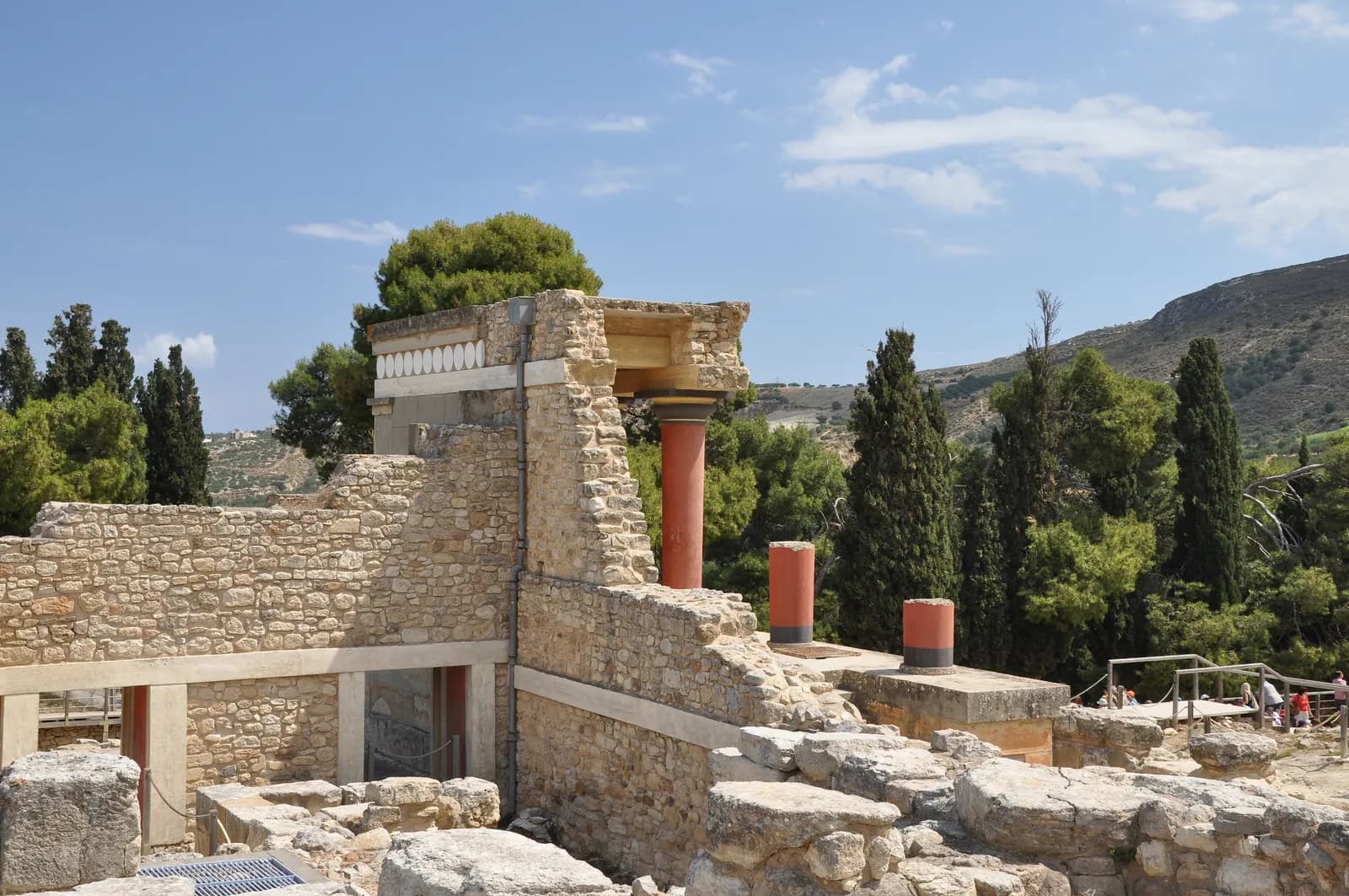
Rising above that is Arthur Evans's reconstruction: reinforced concrete columns, painted red and black, upper storeys and roofs rebuilt where he judged they had been, copies of frescoes set into the walls. Almost every photograph of Knossos shows a building substantially of the 1920s. Evans called it reconstitution and defended it as the only way to keep gypsum and mudbrick from dissolving in Cretan rain, which was a real problem; the concrete has since developed problems of its own.
The frescoes on the walls are replicas. The originals, and the fragments they were built out of, are in Heraklion.
Occupation and chronology
Dates below are stored as signed years and rendered with the precision they actually carry. c. 7000 BCE is approximate; c. 1300 BCE is disputed.
c. 7000–3000 BCE
Neolithic mound
Seven metres of Neolithic deposit lie under the central court. The palace was built on top of one of the oldest continuously occupied places in Europe, and that deposit is why the court is where it is.
c. 1900–1700 BCE
First palace
The central-court plan is established. Destroyed, probably by earthquake, around 1700.
c. 1700–1450 BCE
Second palace
The building as it is now presented: multi-storey, light wells, gypsum facing, the frescoes, the Linear A archives. The high point of the Cretan system.
c. 1450–1300 BCE
Mycenaean administration
Linear B — that is, Greek — appears in the archives while the building remains in use. Whether this represents conquest, dynastic replacement or something less dramatic is argued, but the language of administration changed.
History of excavation
Who recovered the evidence, when, and by what method. Where an excavation destroyed as much as it found, the entry says so.
- Evidence level: Documented
1878–1879
Minos Kalokairinos
A Heraklion merchant sank trial trenches on the west side and struck the magazines and their storage jars. The Ottoman authorities stopped him. Schliemann tried to buy the site afterwards and failed over the price.
- Evidence level: Documented
1900–1931
Arthur Evans, funded privately and latterly on his own land
Six weeks into the first season the throne room was open. Evans bought the site outright, dug it for three decades, published it in four volumes, and named the civilization he had found after the Minos of Greek legend — a coinage, not a finding.
- Evidence level: Documented
1922–1930
Evans with the architects Christian Doll and Piet de Jong
The reinforced-concrete restorations. De Jong also drew the reconstructions that fixed the popular image of Minoan Crete.
- Evidence level: Documented
1957–1961 and after
Sinclair Hood and the British School at Athens
Stratigraphic re-excavation and survey which corrected parts of Evans's sequence and established the extent of the surrounding town, which is far larger than the palace.
Principal structures
The evidence level answers how we know what a structure looked like, not whether it existed.
- Evidence level: Documented
c. 1900 BCE, on Neolithic deposit
The central court
Paved, aligned roughly north–south, and the organising fact of the whole building. Every Cretan palace has one.
- Evidence level: Documented
c. 1450–1300 BCE in its final form
The throne room
A gypsum seat against the north wall with benches either side and a sunken basin opposite. The griffins flanking it are a restoration by Émile Gilliéron from fragments; the seat itself is ancient and in place. Whether a king sat in it, a priestess sat in it, or it held something rather than someone, is not established.
- Evidence level: Documented
c. 1700–1450 BCE
The west magazines
Long parallel corridors lined with pithoi and floor cists. Storage on this scale is the strongest single argument that the building was an administrative and redistributive centre whatever else it was.
- Evidence level: Probable
c. 1700–1450 BCE
The grand staircase
Four flights around a light well on the east slope. Excavated as a collapse and rebuilt in concrete; the arrangement is Evans's reading of the fallen material.
- Evidence level: Documented
c. 1700 BCE
The theatral area
A paved rectangle with stepped sides at the north-west entrance. Called theatral by Evans; it is stepped seating of some kind for something that happened in front of it, and that is as far as the evidence goes.
Finds and where they went
Almost nothing recovered from these sites is still on them. Where an object has a full provenance record on this platform, it is linked.
- Evidence level: Documented
Linear A tablets and inscriptions
The script of the second-palace administration. The signs can be read; the language cannot. It remains undeciphered, and no bilingual has been found.
- Evidence level: Documented
Linear B tablets
Some three thousand tablets and fragments from the final phase. Michael Ventris demonstrated in 1952 that the language is Greek, with John Chadwick; Evans had been convinced it was not, and did not live to see it.
- Evidence level: Disputed
The bull-leaping fresco
Three figures and a charging bull, from the east wing. Assembled from a small proportion of original plaster; the surrounding field and much of the composition are restoration.
- Evidence level: Disputed
The faience snake figurines
Two small female figures holding snakes, from a cist in the temple repositories. Both were restored — one is missing its head, and the cat now on it was found nearby rather than attached.
- Evidence level: Documented
Material in Oxford
A substantial study collection went to the Ashmolean Museum under the division-of-finds arrangements of the period and Evans's own bequest.
Ashmolean Museum, Oxford
Ancient testimony
What ancient authors say about the place, and how far it can be trusted.
Homer, Odyssey 19.172–179
Odysseus, lying, describes Crete of the ninety cities and Knossos where Minos ruled. The earliest surviving Greek reference to the place, in a speech that is explicitly a fabrication.
Thucydides, History of the Peloponnesian War 1.4
Thucydides' brief statement that Minos was the first to hold a navy and cleared the sea of pirates — the source of the idea of a Cretan thalassocracy, offered by him as reconstruction rather than record.
How the site has been interpreted
Evans read the building as a palace and its culture as a peaceful, matriarchal-leaning, sea-ruling civilization destroyed from outside — a reading formed in the shadow of a European empire that thought of itself in those terms, and one that has been under revision ever since. The word palace is now often replaced by court-centred building, precisely because palace smuggles in a king.
What the archaeology supports is narrower and more interesting. There was a very large building organised around a court, with storage capacity far beyond the needs of its occupants, workshops, archives in an undeciphered script, and no fortification. Something was being collected, counted and redistributed. Whether the organising authority was a ruler, a priesthood, a corporate elite or a shifting combination is not recoverable from what survives.
The absence of walls is the strongest negative evidence in Aegean archaeology, and it is genuinely hard to explain in a Bronze Age world where Mycenae, Tiryns and Troy were all walled. Naval control, internal peace and a different relationship between settlement and defence have all been proposed.
The Minotaur is not evidence about Knossos. Bulls appear constantly in Cretan art, the building is complex, and a Greek myth about a labyrinth on Crete existed by the eighth century BCE at the latest. Those three facts are compatible with the myth having grown around a half-remembered ruin, and equally compatible with coincidence. The derivation of labyrinth from labrys, the double axe, is a nineteenth-century proposal that has not been established.
Unresolved
How much of the visible building is ancient?
Evans's restorations are not a secret and were published as restorations, but they are not marked on the site, and a visitor cannot tell concrete from gypsum at a distance. Critics from the 1920s onward have argued that the reconstruction fixed a set of hypotheses in permanent material, making them unfalsifiable. Defenders point out that unroofed gypsum was actively dissolving and that the alternative was loss. Both are true.
What happened around 1450 BCE?
Cretan sites were destroyed widely around this date, and Knossos alone continued in use with Greek-language administration. Mycenaean conquest is the traditional explanation; earthquake, internal collapse and the long aftermath of the Theran eruption have all been argued as contributing. The change of administrative language at Knossos is documented; its cause is not.
Was there human sacrifice?
Peter Warren's 1979 excavation of the North House produced children's bones with cut marks consistent with butchery. The interpretation offered was ritual, and it is contested; the sample is small and the alternative readings — secondary burial practice, disturbance — are not excluded. It should not be generalised into a characterisation of Cretan religion.
How to read the evidence labels
- Evidence level: Documented
- Supported by a named primary text or by excavated material evidence.
- Evidence level: Probable
- Supported by strong inference that most specialists accept.
- Evidence level: Disputed
- Substantial specialist disagreement exists; competing readings are stated.
- Evidence level: Literary
- Belongs to poetic or mythological construction rather than to history.
- Evidence level: Mythological
- Belongs to shared religious or mythic tradition rather than to any single text.
- Evidence level: Unknown
- The available evidence is insufficient to decide.
These labels describe the status of the evidence, not our confidence in a conclusion. A claim marked Literary is not a claim we doubt; it is a claim about what kind of thing a poem is.