Recovery as a possibility
The crisis of the third century is usually read as a story of collapse, and for fifty years it was. Aurelian is the proof that it did not have to end in dissolution. In a reign of barely five years (270–275 CE) he reversed, by force of arms, the physical fragmentation of the empire — defeating the Germanic invaders, reconquering the Palmyrene state in the east and the Gallic Empire in the west, and reuniting under one authority a Roman world that had split into three. The platform reads Aurelian as the figure of recovery: the demonstration that the crisis was survivable, and the preview of the militarised monarchy that survival would require.
The Illyrian soldier
Aurelian was the type the crisis produced — a career officer of humble Balkan origin, raised to the purple by the army on the strength of demonstrated competence in the field. He had no dynastic claim and no senatorial standing; he had the legions and a record of victory. His campaigns were astonishingly compressed: the defeat of Zenobia's Palmyrene empire and the recovery of the east, then the reabsorption of the Gallic provinces, accomplished in the space of a few years. For these he was hailed restitutor orbis — restorer of the world. Under the army-and-state theme he embodies both the disease and the cure of the age: the empire was now made and saved by soldiers, and the same force that raised him would, in 275, murder him in a conspiracy of his own officers — the characteristic death of the barracks emperors.
The walls and the sun
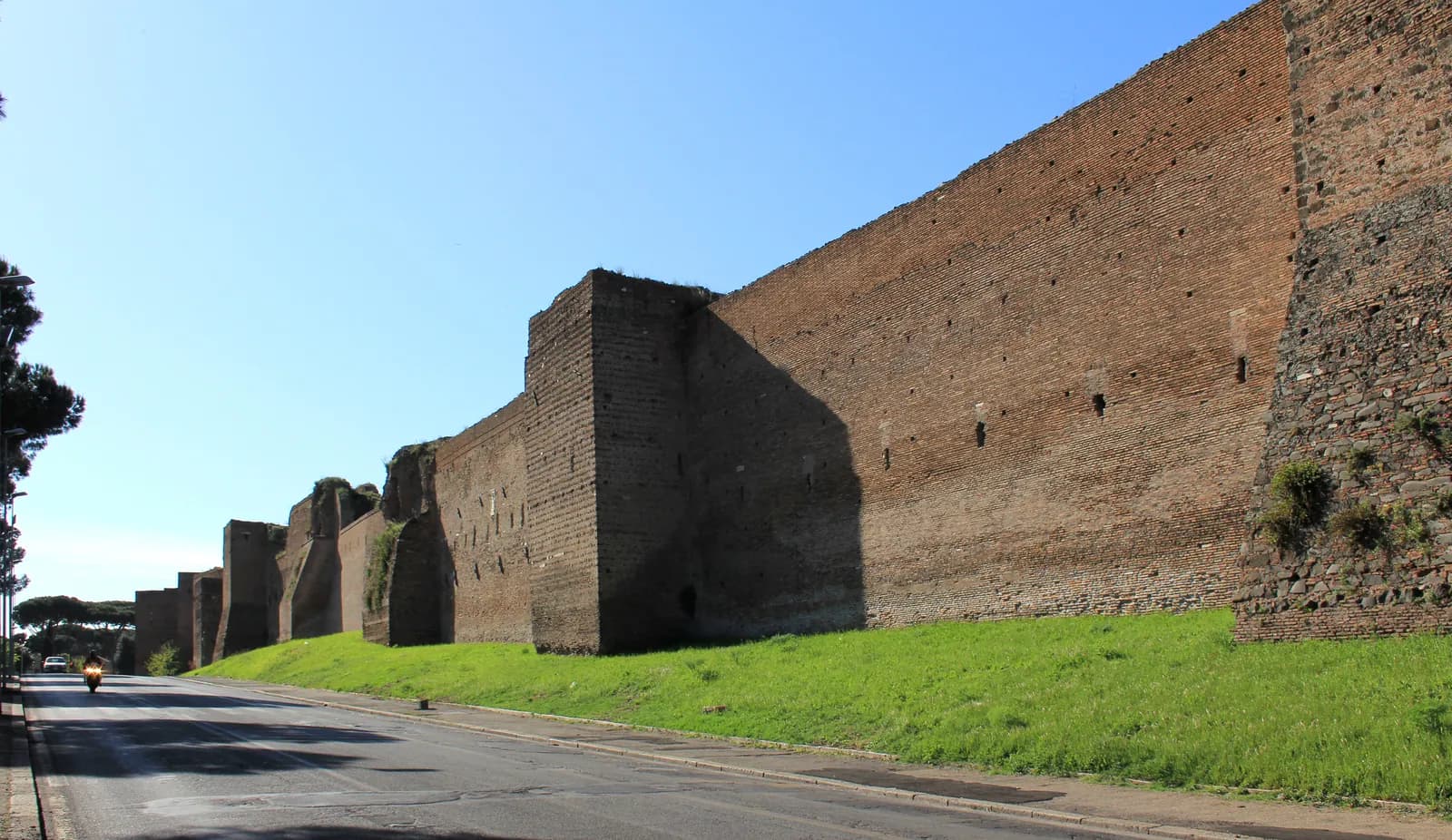
Two of Aurelian's acts read the new condition of the empire most clearly. He built a massive new circuit of walls around Rome itself — the Aurelian Walls, much of which still stands. For three centuries the imperial capital had needed no defences; that it now did was the plainest possible statement that the pax Romana of the interior was over and the frontier was no longer reliably far away. And he promoted the cult of Sol Invictus, the Unconquered Sun, as a unifying state religion centred on the emperor — an attempt, under the state-and-religion theme, to give the fragmenting empire a single transcendent focus of loyalty above its many local gods. It was a direct ancestor of the religious universalism the next century would resolve in Christianity.
Why the platform reads him
The platform reads Aurelian because he is the bridge figure between catastrophe and reconstruction. He showed that the empire's fragmentation could be undone, but only by a soldier-monarch ruling through the army, walling his own capital, and reaching for a unifying state cult — the elements that Diocletian would, a decade later, organise into a permanent system. Aurelian is the improvised, personal version of the recovery; Diocletian made it structural. He is read here under the crisis-of-the-third-century and army-and-state themes, and beside Diocletian, whose reordered empire his victories made possible.