What it is
The Ishtar Gate — Nebuchadnezzar's glazed brickwork and its animals, Koldewey's excavation and the shipment to Berlin, what the Pergamon reconstruction actually contains, and Iraq's claim.
Built Built under Nebuchadnezzar II, c. 575 BCE. The principal date, c. 575 BCE, is approximate.
c. 575 BCE
Construction
Nebuchadnezzar II's building inscription, found at the gate, records its construction in glazed brick with bulls and dragons.
6th century BCE
Rebuilding in successive levels
The gate was rebuilt at least three times as the street level rose, so earlier unglazed levels survive below the glazed one, with their moulded animals intact and never meant to be seen.
1899–1917, shipped 1926–1927
Excavation and removal
Robert Koldewey excavated the gate and the Processional Way for the German Oriental Society. Fragments were shipped to Berlin under the division-of-finds arrangements of the Ottoman and then the British Mandate period.
opened 1930
Reconstruction in Berlin
Reassembled in the Pergamon Museum from the excavated glazed bricks with new brick filling the losses.
Who ordered it built
Each attribution carries what supports it. Ancient buildings are routinely credited to people on the authority of writers centuries later, and that is not the same claim as an inscription on the building.
- Evidence level: Documented
Commissioned by
Nebuchadnezzar II
His own building inscription from the gate, which names him, the gate, and the animals of bronze and of glazed brick set on it.
What it was for
The eighth gate of the inner city wall of Babylon, on the Processional Way that ran from the north into the city and past the temple precinct to Esagila and Etemenanki.
It was the route of the New Year procession, when the statue of Marduk was carried out and back. A gate on that road is a piece of ritual apparatus as much as a piece of fortification.
How it was built
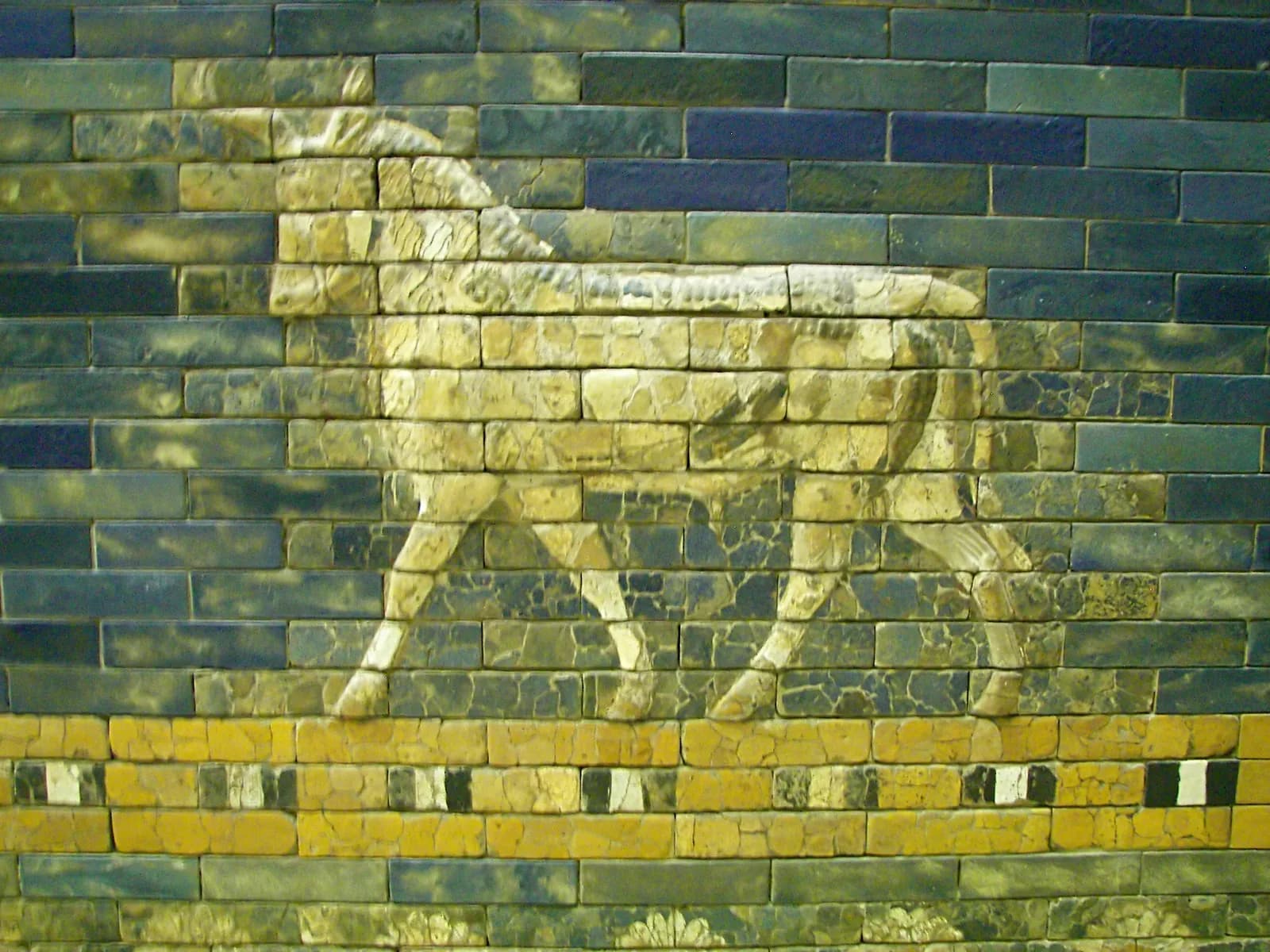
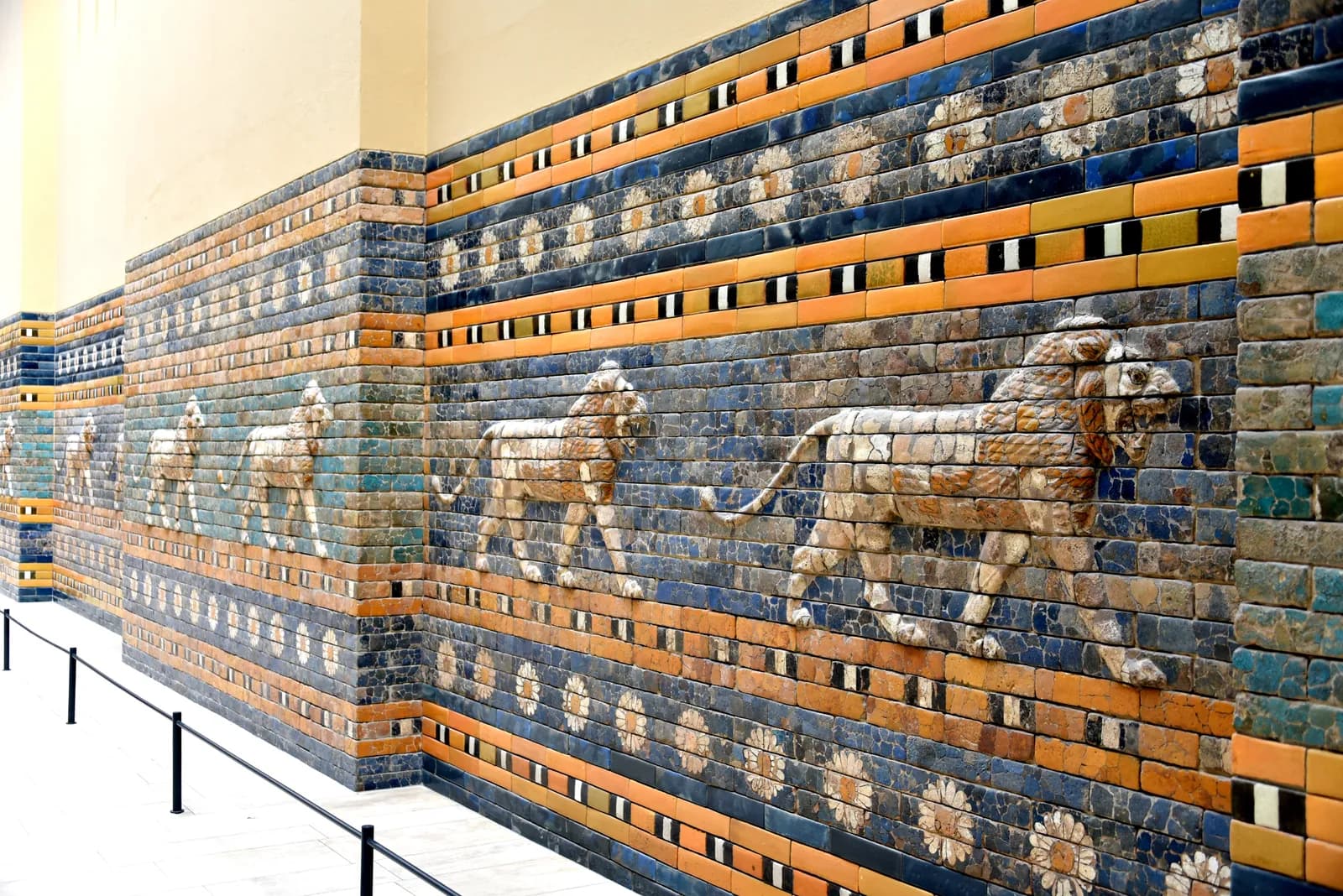
The animals are moulded, not painted: each beast is built from dozens of bricks each carrying part of the relief, cut and numbered before firing so that the courses assemble into a figure. Getting a hundred separately fired bricks to compose one bull, at scale, repeatedly, is the achievement.
The glaze is a soda-lime silicate coloured with copper for the blue and antimony compounds for the yellow, fired at a temperature that had to be controlled closely enough not to slump the relief.
The gate's earlier levels were left in place beneath the glazed one, so the same animals exist in unglazed moulded brick underground. Those were never intended to be seen after the rebuilding, and they are among the best-preserved elements because they were buried.
Materials
- Evidence level: Documented
Glazed brick
The visible surfaces, in deep blue with animals in white, yellow and brown — the glaze technology is the monument's technical achievement
- Evidence level: Documented
Moulded unglazed brick
The lower, earlier gate levels, whose animals are moulded in relief and were buried as the street rose
- Evidence level: Documented
Bitumen and reed matting
Bedding and waterproofing in the foundations, standard Babylonian practice
Measured
Every figure states what it rests on. A modern survey, an ancient text, a conversion from an ancient unit and a modern estimate are four different kinds of statement and are not interchangeable.
The Berlin reconstruction
about 14 m high and 30 m wide
Modern measurement of the reconstructed structure in the museum.
The original gate
substantially larger; the reconstruction shows only the smaller front arch
Koldewey's excavation record and the surviving foundations. The larger rear arch was not reconstructed — it would not fit the museum hall — and its material remains in storage.
Animals on the gate
recorded in the building inscription and counted in hundreds across the gate and the Processional Way
Excavation record. Published counts vary because the several rebuilding levels are counted differently.
What it meant
Nebuchadnezzar's building inscriptions are relentless about his own works, and this gate is their showpiece: the entrance to a rebuilt capital, on the ritual route, in a material nobody else was using at this scale.
The animals divide by god — the dragon of Marduk, the bull of Adad, the lion of Ishtar on the Processional Way — so the walk into the city is a walk past the pantheon in order.
The gate's presence in Berlin is a live question. Iraq has sought its return, and the removal took place under arrangements made with the Ottoman authorities and then in the mandate period. The Pergamon Museum has held that the material was legally acquired and that the reconstruction is itself a scholarly object. The platform records the dispute and does not adjudicate it.
The Processional Way and the gate exist for the akitu, the New Year festival, in which the god's statue left the city and returned and the king's authority was renewed by the god. The route is the ritual.
After antiquity
Buried as Babylon declined. Koldewey excavated it over eighteen years and shipped the fragments to Berlin, where reassembly took until 1930.
The site at Babylon was reconstructed in part under the Iraqi government in the 1980s, including a smaller replica gate, with new brickwork stamped in the manner of Nebuchadnezzar's own stamped bricks. The site was later used as a military base during the 2003 war and suffered damage recorded by subsequent survey.
Condition today
Moved from its site
The glazed façade of the smaller front gate stands reassembled in Berlin, from original bricks with modern infill. The foundations and the earlier unglazed levels remain at Babylon. Panels are also in Istanbul, Chicago, New York, the Louvre and elsewhere.
The Berlin reconstruction combines excavated glazed bricks with new brick where fragments were missing. Which is which is documented in the excavation publications and is not marked on the reconstruction, and photographs almost never distinguish them.
Koldewey's excavation of Babylon from 1899 was among the first large stratigraphic excavations in Mesopotamia and established the city's plan, the Processional Way, the palace and the foundations of Etemenanki.
The fragments were shipped in thousands of crates and reassembled over years, which is why the museum display took until 1930.
Scattered fragments
What has left the building, and where it is now. Where a holding is contested, the museum page says so.
- Evidence level: Documented
The reconstructed gate façade and the Processional Way lions
- Evidence level: Documented
Individual glazed panels distributed to other museums
- Evidence level: Documented
The foundations and the earlier unglazed gate levels
In position at Babylon, Iraq
Written about in antiquity
Nebuchadnezzar II, The building inscription of Nebuchadnezzar II the Ishtar Gate foundation text
The king's own record of the gate: that he laid its foundation with bitumen and baked brick, and adorned it with bulls and dragons so that mankind might gaze on it in wonder.
Herodotus, Histories 1.178–187
Herodotus on the walls, gates and streets of Babylon. His measurements are far too large and his account has been argued to be second-hand, but he describes a hundred bronze gates and a grid of streets running to the river, and the excavated plan is a grid.
Still argued
Should the gate be in Berlin?
Iraq has requested its return. Germany has held that the material left under valid arrangements of the period and that the reconstruction is inseparable from the museum built around it. The excavation records and the division agreements are published and are read differently by each side, and the question is unresolved.
What is the dragon?
The mušḫuššu, a creature with a serpent's head and neck, a scaly body, forelegs of a lion and hind legs of a bird of prey, associated with Marduk. Whether it was understood as a real animal, a composite emblem, or a mythical beast is not recoverable, and attempts to identify it with a known species are not taken seriously.
How to read the evidence labels
- Evidence level: Documented
- Supported by a named primary text or by excavated material evidence.
- Evidence level: Probable
- Supported by strong inference that most specialists accept.
- Evidence level: Disputed
- Substantial specialist disagreement exists; competing readings are stated.
- Evidence level: Literary
- Belongs to poetic or mythological construction rather than to history.
- Evidence level: Mythological
- Belongs to shared religious or mythic tradition rather than to any single text.
- Evidence level: Unknown
- The available evidence is insufficient to decide.
These labels describe the status of the evidence, not our confidence in a conclusion. A claim marked Literary is not a claim we doubt; it is a claim about what kind of thing a poem is.