The argument in one sentence
Tacitus argues that the imperial order, by removing the constitutional constraints under which Roman political life had been conducted, did not merely change the political institutions of Rome; it changed the character of the human beings who lived inside those institutions, and not in the direction the new order's official self-presentation claimed.
The argument is made across the surviving books of the Annales and the Historiae. It is made through the patient analytical Latin of a man who had himself been a successful senator under the regime he describes. It does not have the form of a thesis stated and defended. It has the form of a diagnosis written by someone who knows that the conditions he is describing have produced the very class he belongs to.
The opening of the Annales
The first ten chapters of the Annales are the most uncompromising piece of political analysis to survive from antiquity. The proposition is that the Augustan settlement — the carefully preserved constitutional forms of the Republic, combined with the quiet concentration of substantive power in the princeps — produced a regime in which everyone could act as if the Republic continued while no one could believe it did.
The older generation had seen too much civil war to refuse a settlement that promised peace; the younger generation had been born after the wars and knew no other Rome. The senatorial families that had ruled the Republic were either dead in the civil wars or transformed by the new regime into careful operators of a system in which the older virtues no longer applied. The provincial administration was more competent than it had been under the late Republic; the army was more disciplined; the Mediterranean was at peace. And the form of self-government had become a form whose substance had drained away.
Tacitus's word for this is species — the appearance, the surface form. The senate still met; the consuls still served; the magistrates were still elected; the citizens still bore the name of citizens. What the words had once described was no longer there.
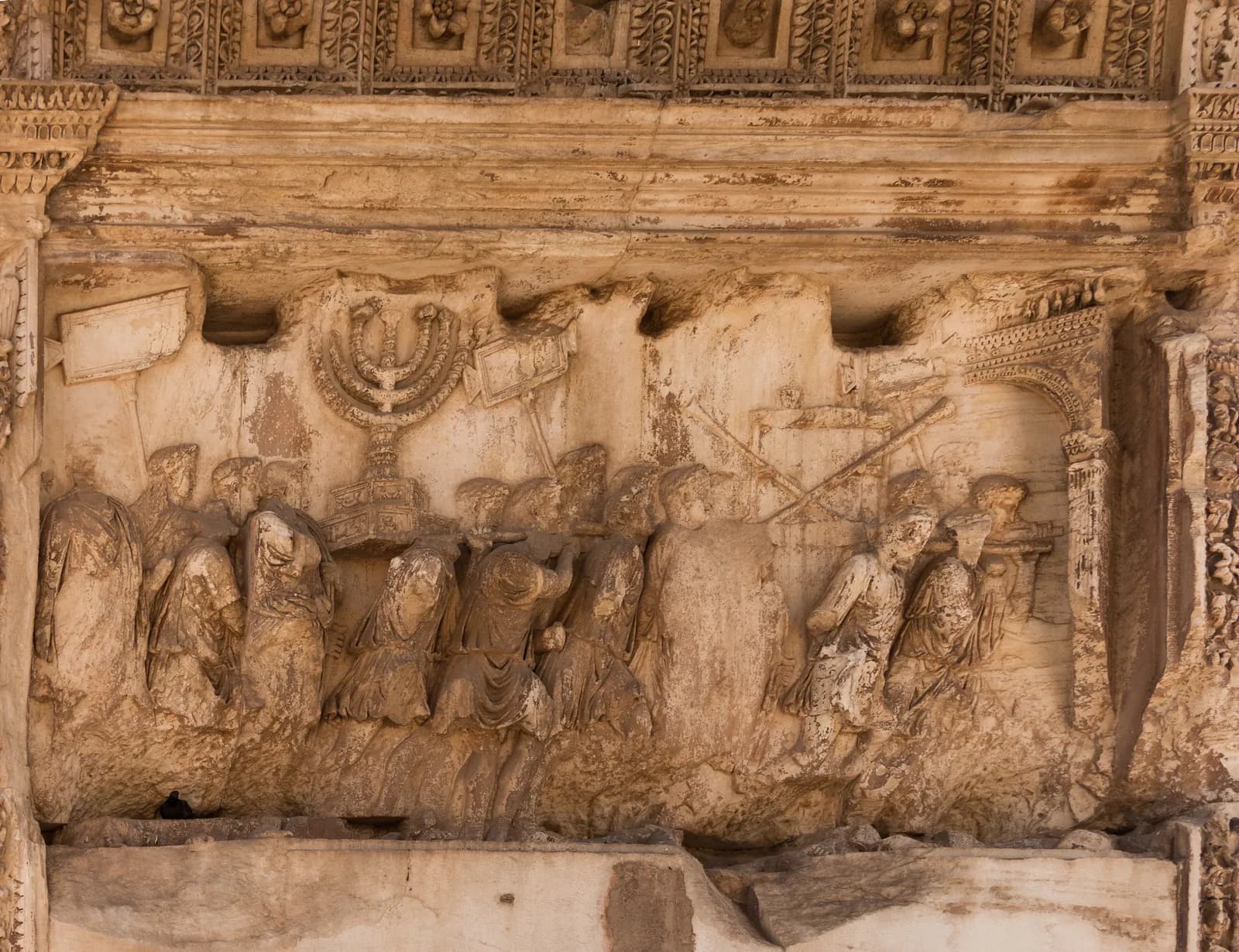
A working visual statement of the imperial order Tacitus describes — the triumphal reliefs in the bay of the Arch of Titus (c. 81 CE) on the Via Sacra in the Forum Romanum, commemorating the Jewish War of 70 CE.
The deformation of character
The longer argument the surviving books make is psychological. The sustained portraits of Tiberius and Sejanus in Annales I–VI; the studies of Nero's court in XIII–XVI; the analyses of the generals and the senate in the year of the four emperors in the Historiae — all of these work the same way. Tacitus shows the deformation of political character that unbounded power produces in the ruler and in those around him.
Tiberius is the paradigm. He had governed Germany competently as a private commander; he had served the Augustan settlement honourably for forty years; he came to the principate at fifty-six, after a long political adulthood under conditions of constraint. The character Tacitus dissects is the character that emerges when those constraints are removed. The closure, the suspicion, the long withdrawal to Capri, the relationship with Sejanus, the calculated cruelties of the last years — these are not, for Tacitus, the essential Tiberius. They are what Tiberius became under conditions that no constraint could absorb. The diagnosis is not that the man was bad. The diagnosis is that the office did not require the man to be good, and that what was not required was, by stages, lost.
The corresponding deformation in the senate is the more uncomfortable part. The senators who flattered Tiberius were not, individually, contemptible men. Many of them had served the Republic; some had been Cicero's contemporaries; their fathers had argued, prosecuted, fought wars. What they became, under the new conditions, was a body of careful operators who knew what could be said and what could not, who fashioned their public language to the requirements of survival, and who understood that political honesty had become — under the new regime — a private virtue at best. Tacitus is one of those operators. He is writing, with terrible clarity, about himself and his class.
Why the analysis matters
The Tacitean diagnosis is not, in its surface argument, a defence of the Republic. The Republic is gone; Tacitus does not propose its restoration. The diagnosis is a description of what was lost when it went, and an analysis of what the regime that replaced it produces in the human beings who live under it. The argument is therefore not about constitutional preference. It is about political anthropology — what kind of human beings are formed under what kind of political conditions, and what the relation is between the political form and the character of those it shapes.
This is what makes the work hard to dismiss. A reader who is satisfied with the imperial peace, the long Mediterranean prosperity, the competent provincial administration, the great works of the high empire, cannot answer Tacitus by pointing at these things. The diagnosis has already incorporated them. The question Tacitus is putting is whether what is being produced inside the citizen body under the new order is the kind of thing a polity should want to produce. The diagnosis is that it is not.
What the European tradition kept
The reception of Tacitus has been one of the longest continuous political readings of any ancient author. The Renaissance, the French politiques, the seventeenth-century neo-Stoic Tacitism, the Enlightenment readings (Montesquieu, Gibbon), the American founders — each took Tacitus seriously as a working diagnostician. Jefferson called him "the first writer in the world without a single exception." John Adams's correspondence is full of him. The conviction the European tradition kept from Tacitus is that constitutional forms can be preserved while their substance drains away, and that the people inside such a form will be deformed by that fact, however the form is dressed. The argument is uncomfortable on purpose. It is one of the things the platform reads the classical tradition for.